How Mercury Scaled Secure Debit and Credit Cards With Lithic



Founded in 2017, Mercury set out to create radically different banking* for ambitious companies that expect more from their financial software. What began as a mission to help more organizations access checking and savings accounts with spend management and corporate cards has evolved into a unified platform that transforms the way modern businesses operate, pay, spend, and grow.
Today, Mercury serves more than 300,000 customers across industries ranging from technology startups and venture capital firms to ecommerce brands and small businesses. Customers rely on Mercury not only for core banking functionality, but for tools that support cash management, payments, corporate cards, and day-to-day financial operations at scale.
From the beginning, Mercury’s founders have believed that delivering this experience requires a world-class commitment to product design, reliability, and control. As Mercury continues to scale their debit and credit card programs, their partnership with Lithic has allowed the fintech to reliably support billions of dollars in card transaction volume, multiple debit and credit card products across consumer and commercial use cases, and proactive fraud protection using 3D Secure (3DS) without compromising the cardholder experience.
Lithic’s Authorization Intelligence—a programmable authorization infrastructure that allows Mercury to make real-time, context-aware decisions on every transaction—has been central to the partnership. Through Authorization Stream Access (ASA) and integrated 3DS with custom challenge flows, Mercury can govern how transactions are approved, declined, or verified at both point of cardholder authentication and payment authorization using live behavioral signals rather than static rules or manual review.
This programmable approach to authorization has enabled Mercury to reduce fraud, minimize false declines, and retain control over the cardholder experience as their card programs have scaled. With Lithic, Mercury has experienced a 40% reduction in total card fraud losses attributed to 3DS transactions, all while continuing to enhance their products and grow their customer base.
The Milestones of a High Growth Fintech
Mercury’s momentum metrics were highlighted in their 2026 annual letter, sharing insights into key growth areas, expansion strategy, and more.
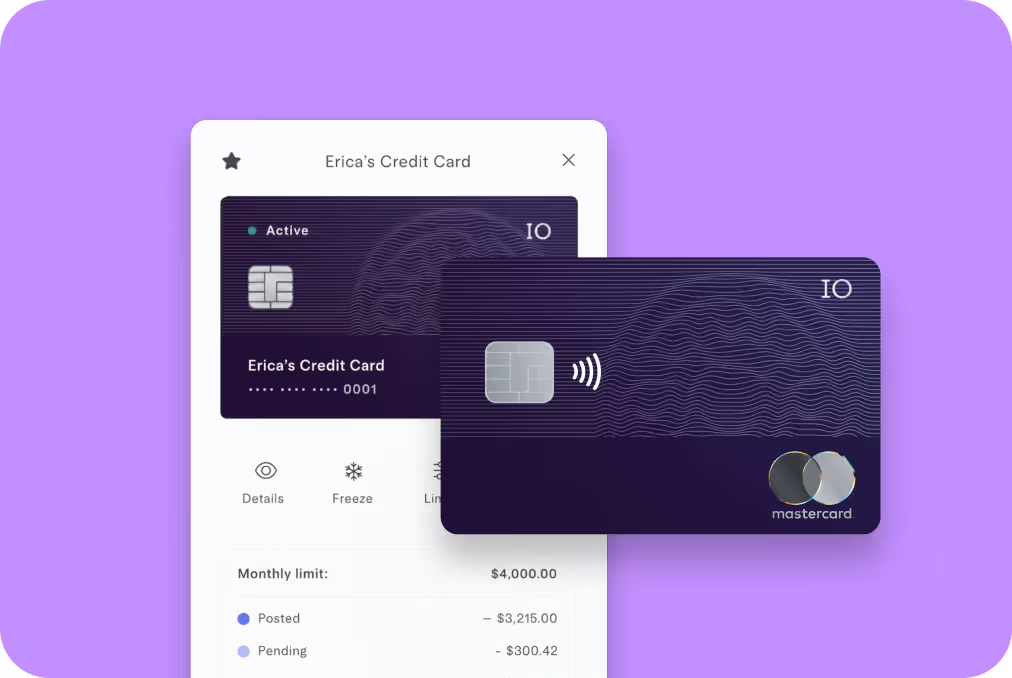
Today, Mercury has scaled to:
14
consecutive quarters of profitability
$650M
in annualized revenue (up from $500M in 2024)
$248B
in transaction volume by the end of 2025, up 59% from $156B in 2024
550%
year-over-year customer growth
At the same time, scaling raised the bar for every part of Mercury’s infrastructure. As transaction volume increased and card programs expanded globally, Mercury turned to Lithic as an issuing and processing partner that could handle the transaction volume, program innovation, and operational needs ahead.
Building the Foundation:
Why Mercury Partnered With Lithic
Mercury partnered with Lithic early on to power their debit and credit card programs. At the time, Mercury was focused on finding an issuing and processing partner that could support strong growth while meeting high standards for reliability and control.
Moreover, Mercury needed a partner that could innovate safely but directly in the authorization path, enabling programmable, real-time decisioning as their card programs and risk requirements evolved.
Ultimately, Mercury’s rationale in selecting Lithic as their critical long-term partner over both legacy and modern competitors was that Lithic:
“Reliability was a non-negotiable requirement for us. We needed a card issuing partner with a modern API, proven scale, and a long track record of operating card infrastructure. Lithic met those requirements early on, and they’ve continued to be both an innovative and dependable partner as our programs have grown.”


Offers a world-class product set
We deliver a comprehensive card issuing and processing platform that supports both debit and credit programs, allowing Mercury to launch and expand their card products without having to stitch together multiple vendors.

Is built to handle volume at scale
As Mercury’s transaction volume grew to billions of dollars per year, our infrastructure performed consistently and reliably. This gave Mercury confidence that their card programs could scale without introducing operational risk or instability.

Provides broad support across bank partners
Our flexible platform allows Mercury to work across multiple bank partners. This flexibility reduces dependency risk and gives Mercury options as it expands their product footprint.

Features flawless reconciliation
We provide detailed, accurate transaction data that enables Mercury to reconcile payments precisely and report to bank partners with confidence. This level of operational accuracy has been critical as transaction volume has increased.

Includes multi-tenancy for distinct card programs
Our platform supports multi-tenancy, enabling Mercury to stand up and manage multiple card programs within a single customer environment. Each program can be configured with its own authorization logic, controls, and parameters, giving Mercury the flexibility to tailor card behavior to different products and use cases while maintaining centralized oversight.

Enables fast, hands-on implementation
We support rapid program setup, configuration changes, and network projects without long queues or handoffs across multiple teams. This allowed Mercury to launch and scale card programs quickly without unnecessary lead times.

Provides embedded program management expertise
Our implementation and account management teams can troubleshoot and correct program configurations directly, without waiting on separate downstream teams. This hands-on support helped Mercury resolve issues quickly as program complexity increased.
These capabilities offered Mercury a stable foundation to launch, operate, and refine their card programs with confidence. And, as Mercury’s customer base and transaction volume have grown, the partnership has evolved to support new products, greater complexity, and more advanced risk and decisioning needs.

Expanding the Partnership as Mercury Scaled
As Mercury grew from tens of thousands to hundreds of thousands of customers, their card programs expanded in both volume and complexity. Lithic continued to support that growth by enabling new card products, digital wallet integrations, instant issuance, and flexible fraud controls.
Specifically, Lithic’s modular platform allowed Mercury to integrate best-in-class technologies across areas such as compliance and monitoring while maintaining control over the core card experience. Throughout this phase, Lithic functioned not only as infrastructure, but as an operational partner with deep knowledge of card networks, issuing requirements, physical card manufacturing and fulfillment, and program management reporting.
This foundation of trust and technical integration positioned Mercury and Lithic to tackle more complex challenges together regarding programmatic auth decisioning as Mercury’s transaction mix evolved.
“Lithic has surpassed our product expectations and has handled hundreds of millions of dollars in monthly volume without issue. We trust their tech and value their deep cards expertise that we can tap into.”

Built In, Not Bolted On: Enabling Mercury to Take Programmatic Control of Fraud Prevention
As Mercury’s transaction volume grew, particularly across online and international spend, 3DS-authenticated transactions emerged as a concentrated source of fraud risk. These transactions represented a disproportionately large share of total card fraud losses, despite accounting for a much smaller portion of overall transaction attempts.
At the same time, Mercury faced a difficult tradeoff. Relying on network stand-in decisioning limited control and visibility, while integrating directly with a third-party Access Control Server (ACS) would introduce another vendor into a critical, real-time authorization flow. Either path constrained Mercury’s ability to mitigate fraud without adding operational complexity or customer friction.


“There’s a huge amount of complexity under the surface of card programs. Having Lithic as more than just an infrastructure provider, but as an advisor on cards, is quite valuable. With other partners, you could be left not knowing what’s going on.”

Rather than treating 3DS as a standalone add-on, Mercury partnered with Lithic to co-develop an integrated 3DS solution designed to sit directly within Mercury’s existing authorization path. This allowed Mercury to maintain end-to-end control over authentication decisions while avoiding the need to introduce a new vendor into a hot-path workflow.
Lithic’s integrated 3DS solution enables Mercury to customize authentication logic on a per-transaction basis using real-time cardholder behavior and transaction context, rather than static and generic merchant category rules—something unimaginable when relying on network stand-in decisioning or off-the-shelf ACS products.
Just as importantly, this integrated solution gives Mercury the ability to associate over 150 possible 3DS authentication data points—including card account holder profile details like email and mailing address, device fingerprints, IP intelligence metadata, and more—directly with the corresponding authorization request. Lithic's authorization layer evaluates 3DS authentication data within the same transaction context, eliminating the latency and data fragmentation that occurs when authorization decisioning and 3DS checks run through separate systems. This made authentication outcomes available for downstream decisioning, strengthening fraud models over time instead of treating 3DS as a disconnected step.
Building on this foundation, Mercury and Lithic continued to co-innovate by introducing 3DS Challenge Flows. This project required re-engineering the 3DS implementation to temporarily pause a transaction, present a challenge to the cardholder, and seamlessly resume the transaction based on the cardholder’s response, all within a defined time window.
To preserve Mercury’s high bar for user experience, Lithic implemented dynamic URLs that route cardholders directly into the Mercury banking app during a challenge. When a challenge is triggered, the cardholder is taken to the specific Mercury account associated with the transaction, completes the verification in a familiar environment, and is then returned to the checkout flow to finish the purchase. This approach minimizes disruption while reducing fraud and identity risk.
Throughout implementation, Lithic collaborated closely with Mercury’s product and risk teams to enable real-time control over authentication decisions. Rather than relying on batch updates, queued requests, or vendor-managed changes, Mercury can update challenge thresholds and decision logic dynamically through Lithic’s authorization infrastructure, with changes taking effect immediately on a per-transaction basis.
This real-time decisioning model allows Mercury to continuously refine challenge logic, user experience details, and fraud rules without slowing development momentum or sacrificing control, even as transaction volume and program complexity increase.
Outcomes:
Measurable Fraud Reduction and Operational Scalability
Within weeks of full rollout, Mercury had already seen the impact extend beyond absolute fraud reduction.
By introducing challenge-based verification, Mercury fundamentally altered the trajectory of their fraud relative to increasing volume. Instead of rising alongside transaction volume, fraud tied to 3DS transactions began to level off as more transactions were confirmed by cardholders in real time. Even as overall transaction volume continued to grow, the share of total card fraud losses attributed to 3DS transactions declined by 40%.
Operationally, preventing fraudulent transactions earlier in the authorization flow led to fewer downstream disputes. Because 3DS authentication data is now associated directly with authorization requests, Mercury can use those signals to inform their broader authorization model without the latency or data silo caused by separate systems, further reducing incorrect approvals, declines, and disputes over time. This unified fraud model has reduced the burden on Mercury’s disputes team and improved the scalability of their card operations, allowing teams to focus on higher-value work as the business continues to grow.
Lithic Continues to Support Mercury’s Fast-Moving Innovation and Growth
Mercury’s work with Lithic on integrated 3DS and challenge flows reflects the latest stage in a long-standing partnership built on execution, expertise, and trust. From powering Mercury’s earliest card programs to developing advanced fraud controls at scale, Lithic has evolved alongside Mercury’s business and product ambitions.
As Mercury continues to expand its platform and serve a growing customer base, Lithic remains a close partner in designing, building, and scaling new card capabilities. Together, the two teams continue to bring secure, reliable, and thoughtfully designed card experiences to market without compromising speed, control, or usability. As fraud and risk shift from static, reactive checks toward real-time, context-driven decisioning at authorization, Mercury’s partnership with Lithic positions the company to stay ahead by embedding programmable intelligence directly into every transaction.
*Mercury is a financial technology company, not a bank. Banking services provided through Choice Financial Group and Column N.A., Members FDIC. The IO Card is issued by Patriot Bank, Member FDIC, pursuant to a license from Mastercard®.